
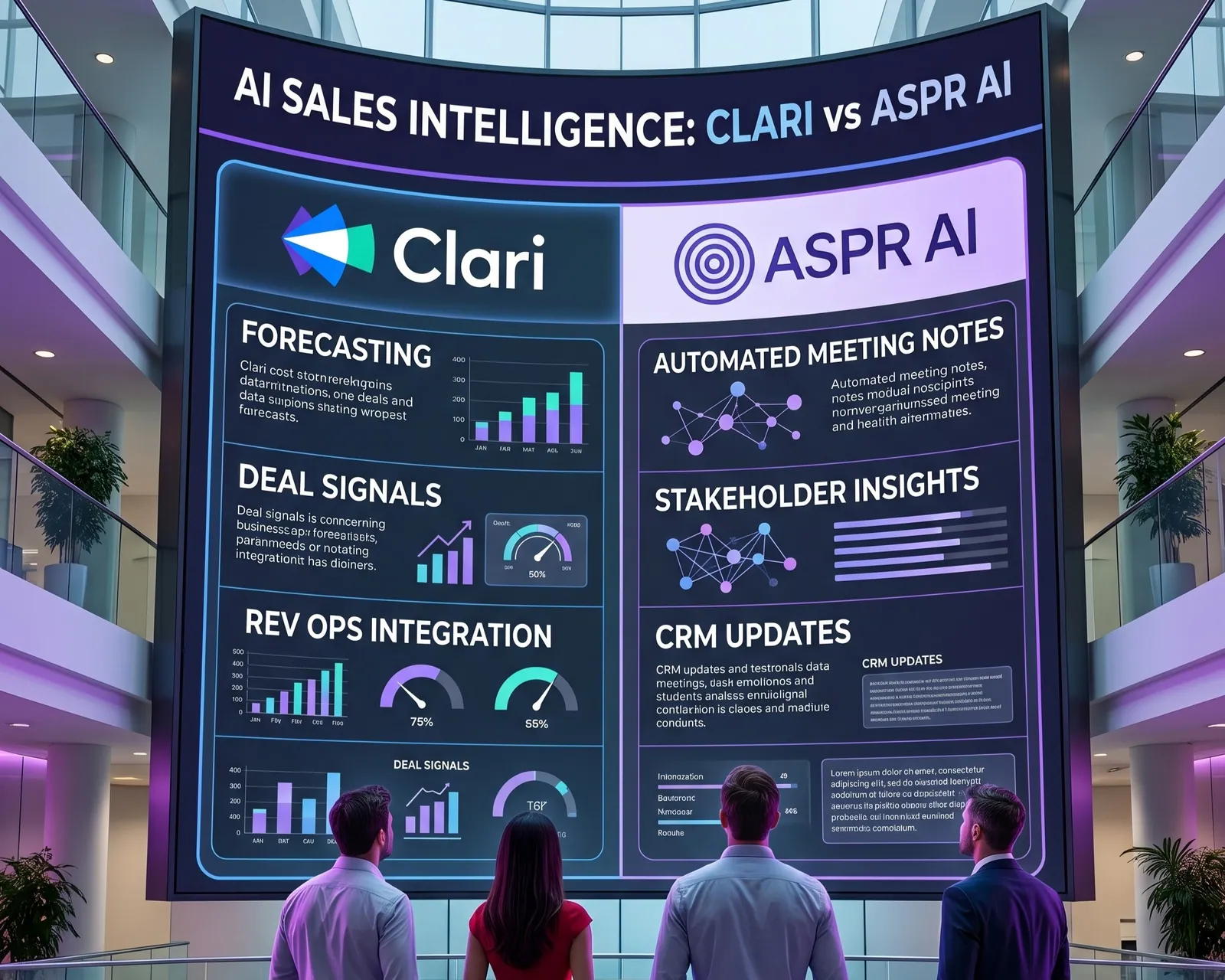
Sales teams in 2026 are asking a different question when evaluating AI software: Does the platform simply analyze sales activity, or can it actively help sellers execute the work?
That question puts ASPR AI and Clari in an interesting comparison.
Both platforms use AI to analyze sales conversations, surface insights, support sellers, and connect sales activity with revenue workflows. However, their product approaches are different.
ASPR AI is positioned as an agentic AI sales assistant designed to support the sales workflow across preparation, meetings, coaching, CRM updates, follow-up, knowledge retrieval, and sales execution. Clari is a revenue platform with products such as Clari Copilot, which focuses on conversation intelligence and real-time sales assistance, and Clari Forecast, which focuses on forecasting and pipeline management.
For sales leaders evaluating the two platforms, the important question is not simply which platform has more AI features. It is which approach fits the team's sales process, coaching requirements, forecasting needs, and level of workflow automation.
TL;DR
- ASPR AI focuses on an AI-assisted sales workflow spanning meeting preparation, sales coaching, CRM automation, follow-up, sales knowledge, and specialized AI agents.
- Clari combines conversation intelligence with revenue workflows, including real-time transcription, live battlecards, buyer signals, CRM capture, and forecasting capabilities.
- ASPR AI's Personalized Coaching Agent analyzes conversations, identifies behavioral gaps, compares rep behavior with successful deals, and creates personalized improvement plans.
- Clari Copilot provides real-time transcription, live insights, battlecards, playbooks, and conversation-based buyer signals that feed into the broader Clari revenue process.
- ASPR AI has a broader AI-agent workflow approach, with separate agents for prospecting, meeting preparation, post-meeting work, CRM updates, coaching, training, documents, knowledge, and email.
- Clari has a stronger product emphasis on revenue intelligence, forecasting, pipeline inspection, and revenue execution.
What Are ASPR AI and Clari?
ASPR AI
ASPR AI describes its platform as an agentic AI sales assistant built from specialized AI agents.
Its current platform includes agents for:
- Prospecting and lead qualification
- Pre-meeting research and preparation
- Post-meeting summaries and follow-up
- CRM updates
- Personalized sales coaching
- Sales training
- Sales document creation
- Sales knowledge retrieval
- Offline meeting capture
- Personalized sales emails
ASPR also positions the platform as a sales execution layer that connects CRM, meetings, and AI agents.
This makes ASPR AI broader than a traditional conversation-intelligence product. The emphasis is on using AI throughout the sales workflow rather than limiting AI to call analysis.
Clari
Clari is a revenue platform focused on helping organizations improve revenue predictability and execution.
Clari Copilot provides conversation intelligence, including real-time transcription, live insights, battlecards, playbooks, buyer signals, and automated capture of intent, objections, contacts, and next steps.
Clari Forecast focuses specifically on forecasting and pipeline visibility. Clari describes Forecast as a platform for real-time revenue insights, pipeline management, forecasting, and revenue predictability.
That gives Clari a broader revenue-management orientation, particularly for sales leadership and RevOps teams.
ASPR AI vs Clari: Core Feature Comparison
| Capability | ASPR AI | Clari |
|---|---|---|
| Conversation intelligence | Yes | Yes |
| Real-time transcription | Sales conversation analysis and coaching | Yes |
| Real-time coaching | Personalized coaching and conversation guidance | Live insights and battlecards |
| AI sales agents | Core platform approach | AI capabilities across revenue workflows |
| Meeting preparation | Pre-Meeting Agent | Conversation and revenue context |
| Post-meeting follow-up | Dedicated Post-Meeting Agent | Automated conversation/CRM capture |
| CRM automation | Dedicated CRM Agent | Captures key conversation information into CRM |
| Sales coaching | Personalized Coaching Agent | Copilot coaching, playbooks and Gametapes |
| AI sales training | Training Podcast Agent and personalized learning | Gametapes and conversation-based learning |
| Forecasting | Supports deal and sales workflows | Dedicated Forecast product |
| Pipeline management | Sales workflow and opportunity support | Core revenue-management capability |
| Sales knowledge | Dedicated Sales Knowledge Agent | Revenue and conversation context |
| Sales documents | Dedicated Document Agent | Revenue workflow capabilities |
| Prospecting | AI Seller Agent | Revenue and sales engagement capabilities |
| Integrations | 100+ apps according to ASPR | Integrates with CRM and revenue workflows |
The important distinction is platform orientation. ASPR AI emphasizes specialized agents that perform or support individual sales tasks, while Clari brings conversation intelligence into a larger revenue orchestration and forecasting environment.
AI Sales Coaching: ASPR AI vs Clari
Sales coaching is one of the clearest areas where the two platforms overlap.
ASPR AI's Personalized Coaching Agent analyzes customer interactions and identifies areas for improvement in areas such as discovery, objection handling, value articulation, and closing. It also describes behavioral gap analysis against top-performing reps and personalized 30-60-90 day improvement plans.
Clari Copilot approaches coaching through conversation intelligence. Its product includes Battlecards, Playbooks, and Gametapes, while conversation data is connected with the broader revenue process.
The difference is therefore less about whether both support coaching and more about how coaching fits into the overall platform.
ASPR AI places personalized coaching alongside AI agents for preparation, CRM work, follow-up, knowledge, and training.
Clari places coaching alongside conversation intelligence, buyer signals, pipeline, forecasting, and revenue execution.
Real-Time Sales Coaching
Real-time coaching is becoming an important part of AI-assisted selling.
ASPR AI says its Personalized Coaching Agent provides real-time coaching insights and conversation-level guidance based on conversation intelligence, buyer signals, and deal context.
Clari Copilot explicitly offers real-time transcription, instant insights, and live battlecards designed to help sellers respond to objections and adjust conversations while calls are happening.
For sales teams evaluating this capability, an important consideration is not simply whether live guidance exists.
The better questions are:
- How relevant are the recommendations?
- Can the coaching use account and deal context?
- Can the team customize sales methodologies?
- Does the system create too many prompts?
- Can managers measure behavioral improvement?
- Does coaching continue after the meeting?
These questions help distinguish a useful coaching workflow from a feature that simply adds another layer of information to the seller's screen.
AI Agents and Sales Workflow Automation
This is one of the more significant differences between the platforms.
ASPR AI's architecture is explicitly built around specialized AI agents.
For example:
- Pre-Meeting Agent → prepares the rep
- Meeting → AI captures conversation intelligence
- Post-Meeting Agent → creates summaries and follow-up
- CRM Agent → updates CRM information
- Personalized Coaching Agent → identifies improvement opportunities
- Sales Knowledge Agent → retrieves relevant sales knowledge
This creates a continuous workflow around the seller.
Clari's approach connects conversation data to its revenue process. Copilot captures buyer signals, objections, contacts, and next steps and feeds that information into Clari's revenue workflows.
For teams primarily looking to improve sales execution and reduce manual work across multiple stages, the agent architecture is an important ASPR AI consideration.
For teams primarily focused on revenue intelligence, pipeline visibility, and forecasting, Clari's platform architecture becomes particularly relevant.
CRM Automation
CRM hygiene remains a major sales productivity issue.
ASPR AI has a dedicated CRM Agent designed to update notes, timelines, next steps, opportunity fields, contact roles, qualification criteria, and deal risks based on sales activity.
Clari Copilot similarly captures information such as intent, objections, contacts, and next steps and connects those signals to the CRM and revenue process.
The difference is primarily the scope of automation.
ASPR AI positions CRM automation as one component of a broader collection of specialized agents.
Clari positions conversation-derived CRM data as part of its larger revenue intelligence and forecasting workflow.
Forecasting and Pipeline Management
Clari Forecast is specifically designed around revenue forecasting, pipeline visibility, revenue insights, and forecast management. Clari says its Forecast product uses historical deal data and AI-powered insights to support forecasting.
ASPR AI approaches the problem from the sales execution side. Its platform connects deal context, meetings, CRM information, coaching, and sales workflows. ASPR's website also positions its AI assistant around helping sales leaders drive more accurate forecasts through contextual coaching and automated workflows.
Therefore, sales teams comparing the platforms should separate two requirements:
"We need forecasting and revenue management."
versus
"We need AI to help sellers execute more of the sales workflow."
These are related requirements, but they address different parts of the sales process.
Which Sales Teams Should Evaluate Each Platform?
There is no single requirement that makes one platform appropriate for every organization. The relevant choice depends on the team's sales process, existing technology stack, coaching model, forecasting requirements, and desired level of AI automation.
ASPR AI may be relevant when the priority is:
- AI-powered sales execution
- Personalized sales coaching
- Automated CRM updates
- Meeting preparation and follow-up
- AI sales agents
- Sales knowledge retrieval
- Sales training
- Reducing repetitive sales administration
- Connecting multiple sales workflows through AI
ASPR AI currently describes integrations with 100+ applications and positions its platform for sellers, sales leaders, RevOps, enablement, and customer success teams.
Clari may be relevant when the priority is:
- Revenue forecasting
- Pipeline inspection
- Revenue intelligence
- Conversation intelligence
- Real-time battlecards
- Buyer-signal analysis
- Forecast visibility
- Revenue execution
Clari's product pages position Copilot and Forecast as connected components of a broader revenue platform.
Questions to Ask Before Choosing
Before comparing demos, sales leaders should define the actual business problem.
Ask:
- Is the biggest problemsales coaching, forecasting, CRM hygiene, or workflow automation?
- Does the team need AI assistance during live customer conversations?
- How much manual CRM work do sales reps perform?
- How important is forecasting to the buying decision?
- Does each rep need an individualized coaching plan?
- Does the organization want specialized AI agents?
- Which CRM and sales tools need to be connected?
- How will AI-generated coaching be measured?
- How will customer conversation data be governed?
- Can the platform fit the existing sales process without creating another disconnected workflow?
These questions are more useful than comparing feature counts alone.
Final Takeaway
ASPR AI and Clari approach AI-enabled sales from different directions.
ASPR AI is built around an agentic sales-assistant model, with specialized AI agents supporting preparation, meetings, coaching, CRM updates, follow-up, knowledge, training, and other sales activities.
Clari combines conversation intelligence and revenue management, with Copilot providing real-time transcription, live battlecards, buyer signals, CRM capture, and coaching, while Clari Forecast focuses on forecasting and pipeline management.
For a sales organization evaluating the two, the most useful comparison is therefore not simply ASPR AI vs Clari.
It is:
What does the sales organization need AI to actually do?
If the priority is building an AI-assisted sales workflow across preparation, conversations, coaching, CRM, and follow-up, ASPR AI's agent-based approach is aligned with those use cases.
If the priority centers on conversation intelligence combined with revenue forecasting, pipeline visibility, and revenue management, Clari's product structure addresses those requirements.
The evaluation should ultimately be based on the team's workflow, sales methodology, CRM environment, coaching model, forecasting requirements, integrations, governance, and measurable business objectives.