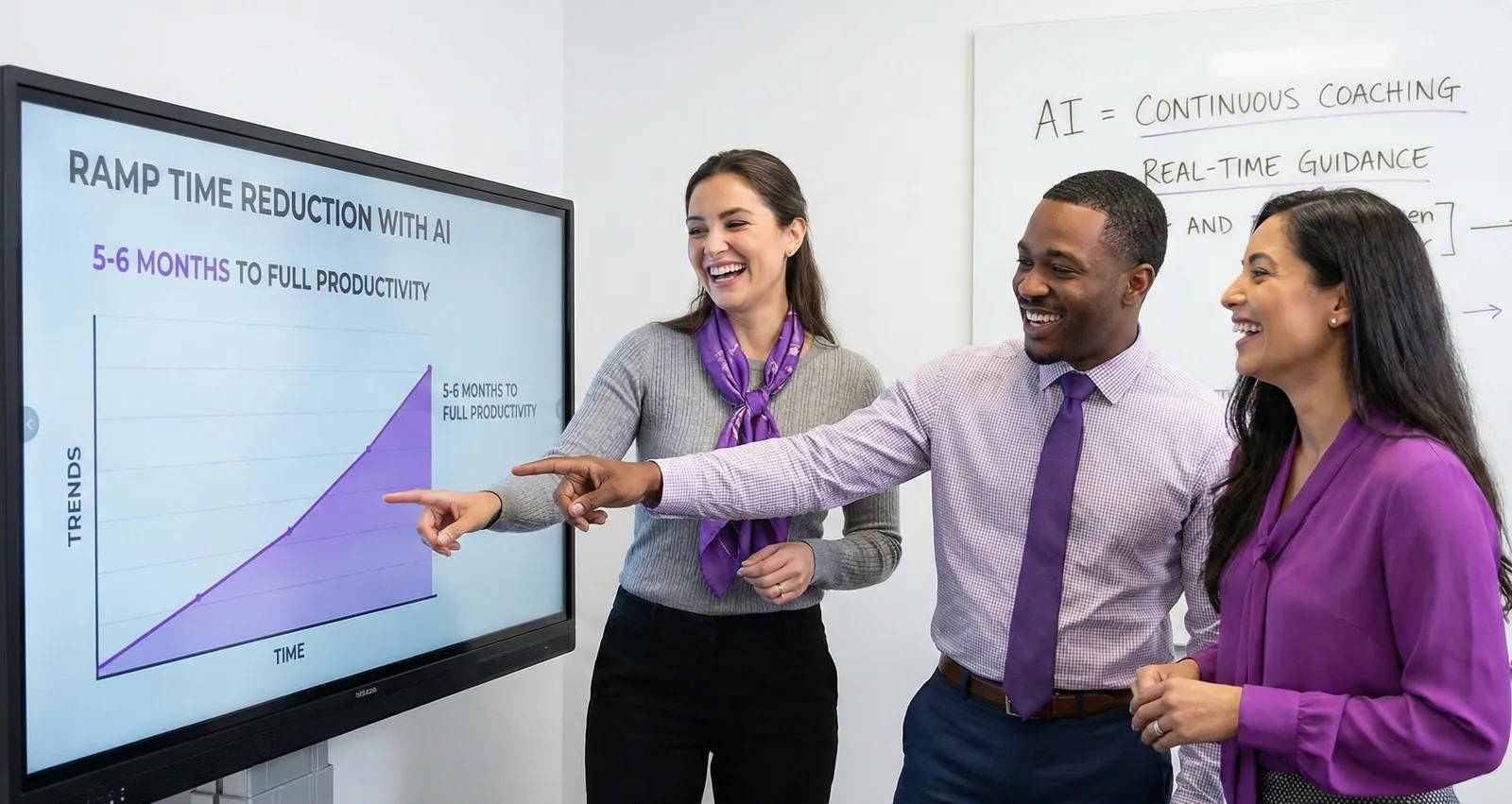
The average sales rep takes close to ten months to reach full productivity. In fast-moving B2B markets, that delay represents lost revenue, missed opportunities, and mounting pressure on sales leaders. As deal complexity increases and buyer expectations rise, traditional sales training models are struggling to keep pace.
Artificial intelligence is changing how sales teams develop talent. Instead of relying on static onboarding programs and sporadic coaching, leading organizations are using AI to shorten ramp time, improve win rates, and create continuous skill development. AI-powered sales training is no longer about automation alone—it’s about building better sellers, faster.
High-performing sales organizations have long understood the importance of coaching. In fact, 65% of high-impact sales teams—where at least 75% of reps hit quota—report that managers spend 20% or more of their time coaching. The results are clear: stronger deal execution, higher win rates, and faster ramp times. AI makes this level of coaching possible at scale.
Why Traditional Sales Training No Longer Works
Sales training was originally designed for simpler buying environments. Reps learned product features, memorized scripts, and shadowed experienced sellers until they were ready to sell independently. That model breaks down in today’s reality.
Modern B2B deals involve more stakeholders, longer decision cycles, and consultative selling motions that require deep discovery and tailored value articulation. At the same time, sales teams face high attrition, forcing leaders to continuously onboard new hires while maintaining performance.
The outcome is predictable. Many reps take months to contribute meaningfully, coaching becomes inconsistent, and knowledge retention drops sharply after initial training. Managers spend hours reviewing calls and deals manually, yet still struggle to provide timely, personalized feedback. Training becomes an event rather than an ongoing system.
The data reinforces this gap. Only 26% of sales professionals receive weekly 1:1 coaching, leaving most reps without consistent guidance when it matters most. Coaching often follows a one-size-fits-all approach, and feedback typically arrives too late to influence live customer conversations.
What is AI Sales Training
AI sales training refers to the use of generative AI, machine learning, and conversational intelligence to analyze real sales activity and deliver personalized onboarding, coaching, and skill development at scale.
Instead of guessing where reps struggle, AI evaluates real conversations, meetings, and deal behavior to guide improvement. It enables sales teams to:
- Analyze actual customer conversations rather than relying on anecdotal feedback
- Identify patterns across top-performing reps
- Detect skill gaps in real time
- Deliver coaching and guidance when it can immediately influence behavior
Training becomes contextual, adaptive, and directly tied to live selling situations rather than static learning modules.
For managers, AI provides clarity. Coaching conversations are grounded in evidence instead of intuition, allowing leaders to focus on strategy and development rather than manual analysis.
How AI Improves Sales Onboarding
The first 90 days of a sales rep’s tenure often determine long-term success. Traditional onboarding overloads new hires with information while offering limited opportunities to practice in realistic conditions. AI changes this experience significantly.
AI-driven onboarding begins with assessment. New reps are evaluated on their existing skills, experience, and learning preferences, allowing training paths to adapt from day one. Instead of moving through generic content, reps receive targeted learning aligned to their actual gaps.
As onboarding progresses, AI-powered simulations allow reps to practice discovery, demos, and objection handling in low-risk environments. These simulations adapt to the rep’s responses, providing realistic buyer behavior and immediate feedback. Reps gain confidence faster because they practice far more frequently than would be possible with manager-led role plays.
Throughout onboarding, AI tracks progress across specific competencies. When a rep masters one area, the system advances them to the next. When someone struggles, additional reinforcement appears automatically. This keeps learning relevant and efficient, significantly reducing time-to-productivity.
The impact is measurable. Teams using AI-powered coaching and onboarding are 36% more likely to improve win rates and 57% more successful than teams without coaching technology, according to industry studies.
Scaling Coaching with AI
Coaching is one of the most powerful levers for improving sales performance, but it is also one of the hardest to scale. Sales managers juggle multiple reps, active deals, forecasts, and internal reporting, which leaves limited time for consistent, high-quality coaching.
AI changes this by analyzing sales conversations automatically and surfacing only what matters most. Instead of manual reviews, managers receive clear, prioritized insights that help them coach more effectively.
With AI-powered coaching, sales leaders can:
- Automatically analyze every sales call without manual effort
- Identify key moments such as objections, buying signals, and missed opportunities
- Track performance indicators like talk-to-listen ratios and engagement levels
- Focus coaching time on the behaviors that have the greatest impact
This shift dramatically improves coaching efficiency. Instead of reviewing full call recordings, managers focus on the moments that matter most, making coaching more focused, actionable, and consistent.
AI also enables just-in-time coaching by delivering post-call insights within minutes, helping reps adjust immediately and improve faster across every conversation.
Real-Time Guidance That Improves Performance
One of the most valuable capabilities of AI sales training is real-time support during live conversations. AI provides in-the-moment guidance without disrupting the flow of the call.
During live sales interactions, AI can:
- Surface relevant content or competitive insights
- Suggest stronger discovery or follow-up questions
- Flag risk signals such as low buyer engagement
- Reinforce value points at critical moments
This doesn’t replace a rep’s judgment. Instead, it provides guardrails—especially for newer sellers. Reps handle objections more confidently, articulate value more clearly, and avoid common pitfalls before deals derail. Learning and execution happen simultaneously, reinforcing each other.
As reps gain experience, reliance on real-time prompts naturally decreases. However, the learning compounds over time, resulting in faster development without sacrificing authenticity.
Accelerating Ramp Time with Precision
Ramp time slows when reps spend time training on skills they already have or lack clarity on what to improve next. AI eliminates this inefficiency through continuous skill assessment and targeted development.
AI helps accelerate ramp time by:
- Continuously assessing rep skills against role expectations
- Benchmarking behaviors against top-performing reps
- Prioritizing the most impactful skill gaps
- Delivering targeted micro-learning and reinforcement
By focusing training where it delivers the highest return, reps stay engaged and productive instead of overwhelmed.
AI also accelerates pattern recognition. New reps learn faster by seeing which behaviors correlate with success across hundreds of deals rather than waiting years to build intuition. Insights such as which questions increase engagement or which signals indicate deal risk help reps make better decisions earlier in their careers.
Combined with micro-learning and spaced reinforcement, AI-driven training improves retention and reduces the likelihood that reps forget critical knowledge weeks after onboarding.
Measuring the Impact of AI Sales Training
One of AI’s greatest advantages is its ability to connect coaching directly to outcomes. Instead of guessing whether training works, organizations can measure its impact with precision.
Sales teams using AI-driven coaching commonly report:
- Faster time-to-first-deal and time-to-quota
- Win-rate improvements of 10–20% over baseline
- Increased deal velocity through better discovery and qualification
- Higher rep retention due to improved confidence and support
On the coaching side, improvements in conversation quality, discovery depth, and objection handling clearly indicate whether reps are applying what they learn. This closed-loop measurement allows sales leaders to continuously refine their training approach and invest more in what works.
Implementing AI Sales Training Successfully
Step 1: Treat AI as a Talent Transformation, Not a Tool
Adopting AI for sales training requires more than adding new software. Organizations must approach it as a transformation in how sales talent is developed, coached, and supported over time.
Step 2: Build a Strong Data Foundation
AI is only as effective as the data it uses. Accurate CRM data, consistent call recording, and clear performance signals are essential for generating reliable coaching insights.
Step 3: Enable Sales Managers First
Manager adoption is critical to success. Leaders need guidance on how to translate AI insights into meaningful coaching conversations rather than simply reviewing dashboards or reports.
Step 4: Start with a Focused Pilot
Launching with a specific use case—such as faster onboarding or improved coaching consistency—helps teams see results quickly. Early wins build confidence and momentum before expanding AI across the organization.
Step 5: Communicate Clearly with Reps
Reps must understand that AI exists to support development, not to monitor or penalize performance. Transparency and trust are key to driving long-term adoption and engagement.
How ASPR AI Helps Sales Teams Train and Ramp Faster
This is where ASPR AI fits naturally into the modern sales training stack.
ASPR AI brings onboarding, coaching, and real-time guidance together through intelligent agents that support reps before, during, and after every sales interaction. From AI-driven onboarding and personalized coaching plans to real-time call insights and post-meeting feedback, ASPR AI helps sales teams ramp faster without adding manager overhead.
For sales leaders looking to turn training into a continuous, measurable system rather than a one-time program, ASPR AI provides the foundation to scale performance across the entire team.
The Future of Sales Training Is Continuous
Sales training is no longer a series of events—it is a continuous process. AI enables organizations to embed learning directly into daily workflows, ensuring that improvement happens naturally as reps sell.
As AI systems evolve, they will move beyond analysis into deeper coaching and strategic guidance. The organizations that benefit most will be those that treat AI as a long-term capability rather than a short-term efficiency gain.
See AI Sales Training in Action
How ASPR AI helps sales teams onboard faster, scale coaching, and reduce ramp time with AI-driven insights.
Request a DemoQuick Summary & Key Takeaways
The most successful sales organizations of the next decade will be defined not by tools or territories, but by how quickly and effectively they develop sales talent at scale. As buyer expectations rise and sales cycles become more complex, traditional training and coaching models can no longer keep up.
AI-powered sales engagement embeds intelligence directly into daily workflows, enabling faster onboarding, continuous coaching, and sustained performance improvement—without increasing managerial overhead. For sales leaders, the question is no longer whether AI belongs in sales enablement, but how quickly it can be integrated to build advantages that competitors will struggle to replicate.